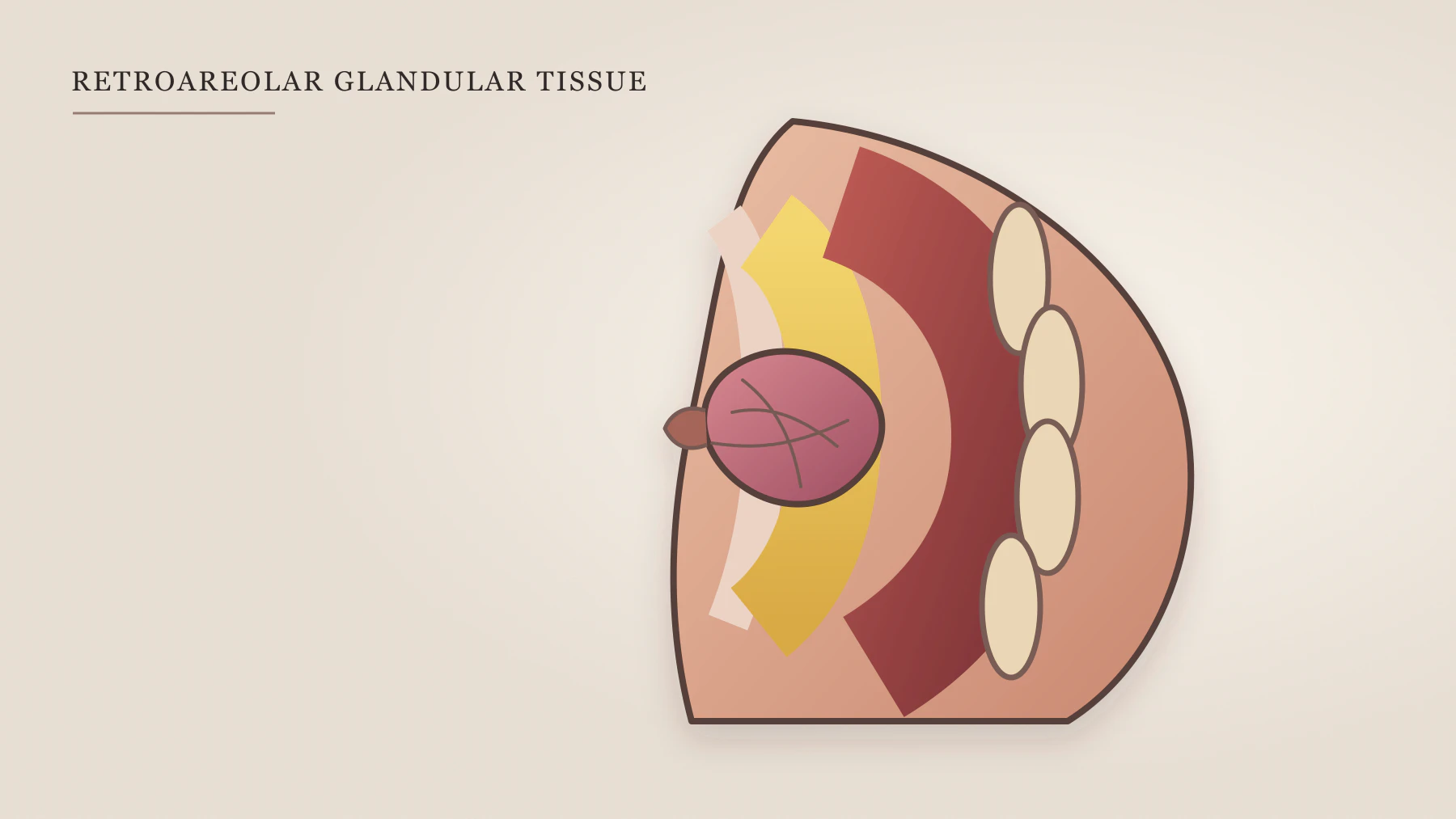
Gynecomastia is the growth of actual glandular breast tissue in men, distinct from chest fat (pseudogynecomastia), and it does not respond to weight loss or exercise. It is one of the most common male chest complaints presenting to surgery, is most often idiopathic or hormonal, and is graded on the Simon scale from 1 to 3, with grade 2 split by whether excess skin is present. The practical test: glandular tissue feels like a firm, rubbery disc directly under the nipple; fat feels uniformly soft.
Every figure on this page carries its source and the date it was measured. See the methodology line under the comparison table.
The practical test above is the fastest check, but it is not a diagnosis. A firm disc under one nipple only, rapid onset, tenderness or nipple discharge should be assessed by a doctor rather than judged from this table alone.
| Sign | Gynecomastia | Chest fat |
|---|---|---|
| Feel | Firm, rubbery disc directly under the nipple | Uniformly soft, no distinct disc |
| Distribution | Concentrated under and around the nipple | Spread evenly across the chest |
| Responds to weight loss | No. Glandular tissue does not shrink with diet or exercise | Yes. Fat responds to overall fat loss |
| Onset | Often puberty, or a hormonal or medication trigger | Tracks with overall body-fat change |
Foreign-patient prices published on Seoul clinics' English-language sites and on Korean medical-tourism platforms (https://us-uk.bookimed.com/clinics/country=republic-of-korea/), measured 2026-07-28.
Localised glandular enlargement under and around the nipple, no excess skin. Often managed by addressing the underlying cause; surgery is not always indicated, and where it is, excision of the disc alone can be enough.
Generalised enlargement across the chest, no excess skin. This is the grade at which Korean private indemnity policies begin treating the operation as therapeutic rather than cosmetic. That is a domestic benefit, but a useful marker of where the clinical line sits.
Generalised enlargement with mild excess skin. Surgery combines gland excision, liposuction and skin tightening; the areola may need repositioning.
Marked enlargement with skin excess resembling breast ptosis and downward-pointing areolae. Needs tissue removal and formal skin resection. This is the one grade where a longer scar is usually unavoidable.
Temporary hormonal gynecomastia during adolescence. The most common presentation overall.
A shift in the oestrogen-to-testosterone ratio, from age, obesity, or an underlying endocrine condition.
Certain heart, ulcer, prostate and psychiatric medications list gynecomastia as a known effect.
External testosterone converts to oestrogen and is one of the more common adult-onset triggers.
Reduced hormone clearance by the liver can shift the same ratio.
Adolescent gynecomastia resolves without treatment in a majority of cases within two years. Persistent gynecomastia in an adult male does not resolve spontaneously, and no medication reliably reverses established glandular tissue. If it started in puberty and it has been more than two years, or it started in adulthood at all, it is worth having assessed rather than waiting further.
Surgery is generally considered for grade 2–3 gynecomastia that has not resolved, or for grade 1 causing significant distress, once reversible causes (medication, an underlying condition) have been checked first. It is elective, and the right approach depends on how much of the enlargement is glandular tissue versus fat versus excess skin; see the grades above. Seoul clinics quote international patients roughly $2,500 to $8,100, and where you land in that band is set by which of the three operations your grade needs, not by clinic prestige. See /procedures/gynecomastia-surgery/ for the technique each grade needs, and /pricing/ for what the figure includes.