Conditions · Peyronie's disease

Scar tissue,
not something you did.

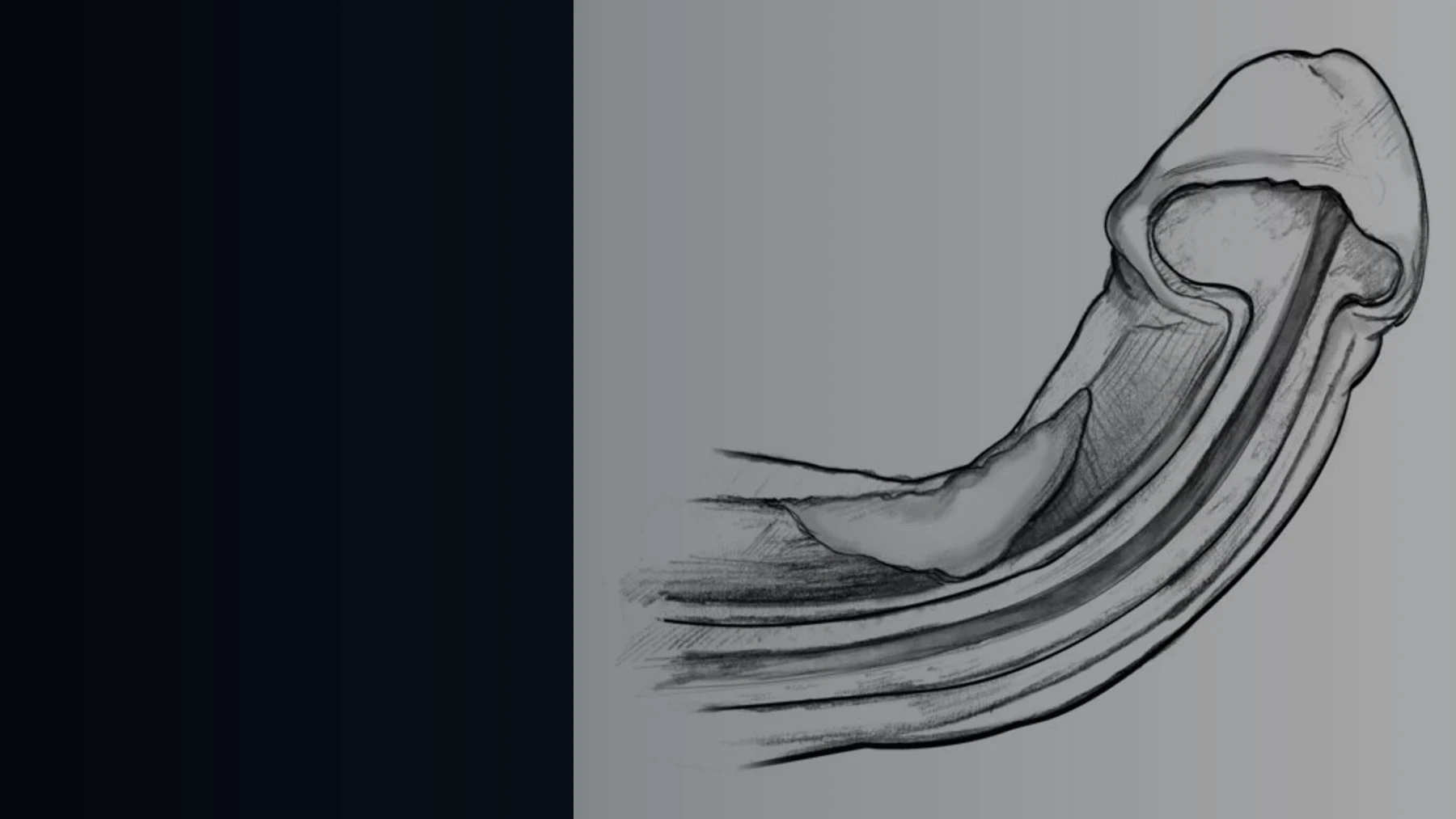
Peyronie's disease is the development of fibrous scar tissue inside the penis that causes curvature, narrowing or pain during erection, most often following a minor injury during intercourse that heals with scar tissue instead of normal elastic tissue. It runs in two phases, and which phase you are in, not how much the curve bothers you, determines what treatment is available.

Image: Medical illustration: NIDDK / NIH · Public domain. Image cropped and tone-adjusted for this page.

Every figure on this page carries its source and the date it was measured. See the methodology line under the comparison table.

Two phases

Which phase you are in decides what is on offer.

Peyronie's is not a static condition that you either treat or do not. It moves through an acute phase in which the plaque is still forming, and then settles into a chronic phase in which it has stopped. Surgery belongs entirely to the second one, and this is the most common reason a patient is told to wait. Not scheduling, biology.

Acute phaseChronic phase
What is happeningThe plaque is still forming; the angle is still changingThe plaque has matured; the angle is stable
Typical durationRoughly the first 6 to 18 months, though it varies widelyOnward, once change has stopped
PainCommon, particularly with erectionUsually resolved by this point
What is offeredNon-surgical treatment and observationSurgery, once stability is established
Why not operate yetCorrecting an angle that is still moving risks correcting it to the wrong oneNot applicable

Foreign-patient prices published on Seoul clinics' English-language sites and on Korean medical-tourism platforms (https://us-uk.bookimed.com/clinics/country=republic-of-korea/), measured 2026-07-28.

Cause

An injury you probably don't remember.

Peyronie's most often follows a minor injury to the erect penis (usually during intercourse, and usually an event nobody noticed at the time) that heals with fibrous scar tissue instead of normal elastic tissue. That is why it so reliably feels like it appeared out of nothing. It is associated with Dupuytren's contracture of the hand and with diabetes, which points to an underlying tendency to form scar rather than to anything that happened. It is not caused by masturbation, and it is not a consequence of anything you did wrong.

What it does

Scar tissue does not stretch.

On erection the affected side stays short while the rest of the shaft expands, which produces curvature, an hourglass narrowing, or a hinge partway along the shaft. Pain is common early and usually settles as the plaque matures. Erectile dysfunction accompanies Peyronie's in a substantial share of cases, sometimes from the disease itself, sometimes because the anxiety it causes becomes its own problem. Whether rigidity is intact is one of only two facts that decide which operation applies. The other is the angle. See /procedures/peyronies-correction/.

FAQ

Questions worth asking before you book.

Does Peyronie's disease go away on its own?
The pain of the acute phase usually settles on its own, and the curve stops changing. The curvature itself does not go away. Established plaque is mature scar tissue, and scar tissue does not remodel back into normal elastic tissue. A minority see some spontaneous improvement in angle; most do not.
Did I cause this?
No. Peyronie's follows a minor injury to the erect penis, most often during intercourse and most often one nobody noticed at the time, that heals with fibrous tissue instead of elastic tissue. It is associated with Dupuytren's contracture and with diabetes. It is not caused by masturbation and it is not a consequence of anything you did wrong.
How long do I have to wait before surgery?
Until the curve has been stable and pain-free for a sustained period. The acute phase typically runs six to eighteen months, but the marker is stability, not the calendar. Operating while the angle is still changing risks correcting to an angle that then moves underneath the repair. A clinic willing to operate on a curve that is still changing is offering you a scheduling convenience at the cost of the result.
Is surgery always needed for Peyronie's disease?
No. Surgery is generally considered only once the disease has stabilised and the curvature significantly affects intercourse. See a doctor before assuming surgery is the only option.